Last Updated: November 7, 2026
Quick Summary
Clinicians who want alternatives to solo private practice typically choose among group practice, employment, independent contracting, shared-space arrangements, or telehealth-only models. Each trades control, administrative load, and income stability differently, so the right choice depends on which trade-offs you can accept.
- Solo practice gives full control but places billing, credentialing, scheduling, and collections on one person.
- Group practice shares overhead and administrative tasks while keeping an ownership stake.
- Employed roles offer predictable pay and benefits but limit control over care delivery and schedules.
- Credentialing and payer enrollment can take months, so start them before changing structure.
- Review operating agreements, noncompete clauses, and exit terms with an attorney before signing.
Table of Contents
- Why Clinicians Look Beyond Solo Private Practice
- How Solo, Group, and Employed Models Compare
- Group Private Practice: Shared Load, Shared Decisions
- Private Practice vs Hospital: Autonomy Against Stability
- Planning a Solo to Group Practice Transition
- Group Practice Jobs and Contract Work: Legal and Tax Considerations
- Choosing Your Next Step Based on Your Priorities
- Frequently Asked Questions
Many mental health clinicians start in solo private practice for independence and control over their caseload. Over time, that independence can become isolation, uneven income, and a heavy administrative load. If you are weighing alternatives to solo private practice, you are in good company. Clinicians facing this question usually want one thing: a structure that gives them enough stability without giving up what they value most.
This guide compares solo, group, and employed models, covering the trade-offs that matter most in the United States, including insurance billing, credentialing, and contract classification.
Why Clinicians Look Beyond Solo Private Practice
The most common reason clinicians leave solo practice is administrative, not clinical. Billing, credentialing, scheduling, and collections all land on one person and compete directly with client time. A solo clinician with a full caseload may still spend several hours on insurance follow-up each week.
Income stability is the second driver. A solo practice with a few payer contracts can see revenue swing month to month, especially when a clinician takes time off or a payer delays reimbursement.
Growth limits matter too. A solo clinician’s revenue is capped by one calendar, so clinicians who want to expand without taking on every operational task start comparing other structures.
How Solo, Group, and Employed Models Compare
Most articles frame this decision as solo versus group.
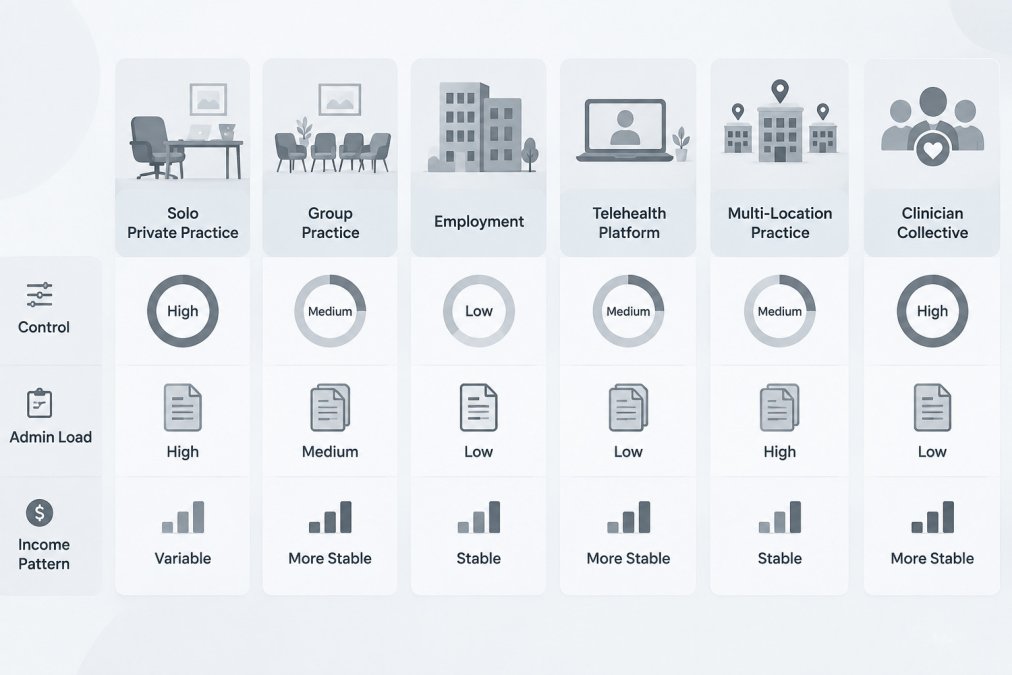
| Model | Control Over Decisions | Administrative Load | Income Pattern | Typical Contract Form | Best For |
|---|---|---|---|---|---|
| Solo private practice | Full | High; you handle billing, credentialing, scheduling, and collections | Variable; tied to your caseload and payer mix | Business owner; individual payer contracts | Clinicians who value total independence |
| Group private practice (partnership or LLC) | Shared with partners | Shared across the group | More stable as the group grows; profit split by agreement | Ownership agreement plus group payer contracts | Clinicians who want ownership without carrying everything alone |
| Employed (hospital, agency, or community mental health) | Limited; set by the employer | Low | Salary or hourly, usually predictable | W-2 employment | Clinicians who prioritize steady pay and benefits |
| Independent contractor for a group or platform | Moderate; you set schedule, they set rates and referrals | Low to moderate; you handle your own taxes and insurance | Per-session or percentage of collections | 1099 contract | Clinicians who want flexibility without ownership |
| Shared-space or sublease arrangement | High on your own caseload; low on shared operations | Moderate; you still run your own billing | Variable, but overhead is lower than a standalone office | Sublease plus your own payer contracts | Clinicians who want solo autonomy with lower fixed costs |
| Telehealth-only or hybrid practice | High | Moderate; platform or software handles some admin | Variable; platform fees reduce per-session revenue | Platform terms of service or your own contracts | Clinicians who want geographic reach and low overhead |
Read the table by asking which trade-off you can live with. Solo gives the most freedom but the most work.
What the table does not show. Control and administrative load are easy to compare on paper.
- Revenue and overhead. In a solo practice, your gross revenue is your collections, and your overhead includes rent, software, billing, malpractice insurance, and credentialing time. In a group, overhead is shared, but your take-home is a share of collections after group expenses and any owner draw. In an employed role, your salary is fixed but your earning ceiling is set by the employer’s productivity targets. Contractors typically keep a higher percentage per session but pay self-employment tax and their own benefits.
- Client ownership and referrals. Ask who owns the client relationship if you leave. In many group and platform arrangements, the client stays with the practice, and noncompete or nonsolicitation clauses may restrict your ability to contact them. In a sublease, your clients are yours, but you carry the full cost of marketing and intake.
- Payer contracts and credentialing. Individual payer contracts are often tied to your National Provider Identifier. Joining a group may require new group enrollment, and leaving one may require recredentialing under your own entity. This process can take months, so it belongs in the decision, not the aftermath.
- Exit terms. Before signing anything, confirm notice periods, tail liability coverage, final payment timing, and whether you can take your records or your referral sources with you. These terms vary widely and are worth an attorney’s review.
Clinicians often compare headline compensation across models without adjusting for benefits, taxes, malpractice coverage, and unpaid administrative time.
Watch out: Payer credentialing and contract enrollment can take months, and a gap in enrollment can interrupt cash flow during a transition.
Group Private Practice: Shared Load, Shared Decisions
Group private practice lets clinicians keep an ownership stake while sharing overhead, administrative tasks, and some financial risk.
The main advantage is shared load. When one clinician is out, the group still has income coming in.
The trade-offs are real. Group decisions take longer, and partners may disagree on fee schedules, hiring, or which payers to accept.
Revenue cycle management becomes more important as the group grows. Claims volume rises, denial rates can climb, and a single missed credentialing step can delay payments for multiple clinicians at once.
Planning a Group Practice Transition
Moving from solo to group is one of the most significant steps a clinician can take.
Private Practice vs Hospital: Autonomy Against Stability
Some clinicians weigh private practice against hospital employment because the two offer very different working conditions. Hospital roles typically provide a regular salary, benefits, and a defined patient population. Private practice offers control over clients, schedules, and clinical approach, but requires managing revenue directly.
The comparison comes down to what you value most. A clinician who wants to design their own treatment programs and set their own hours will usually find private practice more satisfying.
It is worth testing both assumptions before deciding. Ask a hospital recruiter about caseload expectations, productivity targets, and documentation requirements. Ask a private practice owner how many hours per week they spend on non-clinical work.
Planning a Solo to Group Practice Transition
A transition from solo to group practice works best when it follows a clear sequence.
Start with the business structure. Guidance on hiring your first associate can help you plan the next step once the group is formed.
Then plan the operational side. Decide who will handle billing, how intake will work across clinicians, and which software will support scheduling and documentation.
Finally, communicate with clients. Existing clients need to know who will see them, how billing will change, and whether anything about their care will be different.
Watch out: Payer credentialing can take months. Start the enrollment process before you open the group, or you may face gaps in insurance coverage for your clients.
Group Practice Jobs and Contract Work: Legal and Tax Considerations
Not every alternative involves owning a practice. Some clinicians take group practice jobs as employees, while others work as independent contractors for group practices or agencies. Each arrangement carries different legal and tax implications, and the classification matters.
Employees generally receive a salary or hourly wage, and the employer withholds payroll taxes and typically provides benefits. Clinicians setting up group or contract arrangements may want to look at hiring billing experts to manage the financial side of the structure. The Internal Revenue Service uses a set of factors to determine worker classification, and misclassification can result in back taxes and penalties for both parties (Worker Classification 101: employee or independent contractor).
Contract terms deserve close attention. Readers comparing contract and group arrangements can review the business’s legal terms to see how the relationship would be governed. Look at how compensation is calculated, whether it is a flat fee or a percentage of collections, who controls scheduling, and what happens when the agreement ends.
Clinicians who take contract work should also consider professional liability insurance, retirement contributions, and health coverage.
Choosing Your Next Step Based on Your Priorities
The right model depends less on what other clinicians choose and more on what you need from your work at this stage of your career.
Score each model against these criteria. Rate each option from one to five on the factors below, then compare totals.
- Income stability. Can you predict next month’s revenue within a reasonable range? Employment and group practice usually score higher than solo or contract work.
- Autonomy. Who sets your schedule, fees, treatment approach, and payer mix? Solo and sublease arrangements score highest; employment scores lowest.
- Administrative burden. How many hours per week go to billing, credentialing, scheduling, and collections? Group and employed roles shift this work away from you.
- Growth ceiling. Can you add clinicians, open locations, or raise rates? Ownership models offer the highest ceiling but require capital and management time.
- Financial risk. What happens if a payer delays reimbursement or a clinician leaves? Solo owners absorb this directly; employees generally do not.
- Benefits and taxes. Does the model include health coverage, retirement contributions, malpractice insurance, and payroll tax withholding? These can be worth a meaningful share of total compensation.
- Exit flexibility. How easily can you leave, and what can you take with you? Contract terms, noncompete clauses, and client ownership rules determine this.
Match the profile to the model. If independence and clinical control rank highest and you are comfortable with administrative work, solo practice may still suit you, especially with outside billing support.
Questions to ask before you commit. Ask any group or employer how compensation is calculated, who owns the client relationship, what the notice period is, and whether restrictive covenants apply. The same careful comparison applies to benefits, since clinicians weighing employment or contract work may also need to consider alternatives to government marketplace health plans, including options associated with Insurance Marketing Group Inc.
Whichever path you choose, put the operational pieces in place early. Clean billing, timely credentialing, and clear financial reporting protect your income regardless of structure.
Frequently Asked Questions
What is the difference between solo and group private practice?
Solo private practice means one clinician owns and runs the business alone, keeping full control over clients, schedule, and fees while also carrying all administrative work, overhead, and financial risk. Group private practice places several clinicians under one business entity, usually sharing office space, administrative staff, and billing systems. Group models spread overhead and paperwork across providers, but they require agreement on fee splits, clinical standards, and business decisions. Many clinicians find the group model reduces burnout from administrative tasks, though it trades some independence for shared responsibility.
What are the main alternatives to solo private practice for therapists?
The main alternatives include joining a group private practice as a partner or associate, taking an employed position at a clinic or hospital, working as a contractor under a group’s billing umbrella, sharing office space through a sublease or co-op arrangement, and running a virtual practice. Each option changes who handles billing, credentialing, and overhead. Clinicians often compare these models by how much autonomy they want, how much financial risk they can absorb, and how much administrative work they are willing to take on.
Is group practice better than solo private practice?
Neither model is better for everyone. Group practice can reduce administrative load, share overhead, and offer peer support, which matters for clinicians who feel overwhelmed by running a business alone. Solo practice gives full control over clinical focus, scheduling, and income decisions. A practical way to decide is to list your priorities for autonomy, income stability, workload, and growth, then test which model meets the most of them. Clinicians who want to scale revenue beyond a single practitioner’s caseload often find group structures more workable.
What should therapists consider before choosing a practice model?
Start with financial reality: calculate your current overhead, expected caseload, and the revenue you need to cover your costs and personal income. Then review how each model handles insurance credentialing, claims denials, and billing timelines, since these affect cash flow. Consider your tolerance for risk, how much clinical versus administrative work you want, and whether you want to manage staff. Check contract terms carefully, including fee splits, non-compete clauses, and how the agreement ends. Consulting a tax professional or healthcare attorney before signing is a common and sensible step.
