
Table of Contents
- Why Psychiatry Practices Are Turning to Outsourced Billing
- Quick Comparison: 6 Outsourced Billing Services for Psychiatry
- 1. Healthcare Partners Consulting and Billing, Best for Practice Growth
- 2. AnnexMed, Best for Specialized Behavioral Health Coding
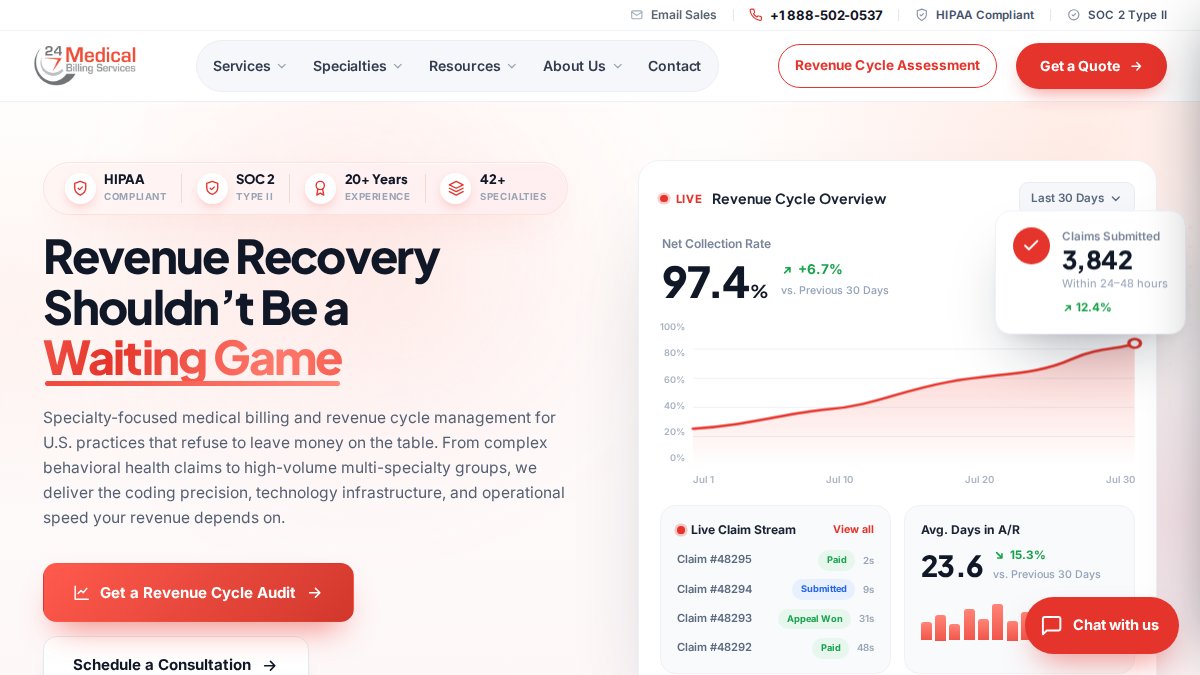
- 3. 24/7 MBS, Best for Continuous Reporting and Monitoring
- 4. The Hamill Group, Best for Replacing an In-House Billing Team
- 5. Osmind, Best for Integrated EHR-to-Billing Workflow
- 6. Checkpoint EHR, Best for All-in-One Practice Management
- Outsourced Credentialing vs In-House Team: What Changes
- Understanding Psychiatry Billing Service Pricing Models
- How to Switch to an Outsourced Billing Company
- What to Look for in a Psychiatry Billing Partner
- Common Pitfalls When Choosing Outsourced Billing
- Making the Decision
- Frequently Asked Questions
Last Updated: October 1, 2026
Why Psychiatry Practices Are Turning to Outsourced Billing
Psychiatry practices face a staffing crisis that directly threatens their financial health. Business operations staff in medical practices, including medical billers, experience turnover rates exceeding 33%, according to the Medical Group Management Association. When a biller leaves, claims pile up, denials spike, and cash flow stalls. The alternative, outsourced billing psychiatry, eliminates this single-point-of-failure risk while addressing a deeper problem: the administrative complexity of behavioral health coding.
Mental health billing has become genuinely difficult. Parity laws, time-based CPT codes, documentation requirements for telehealth modifiers, and evolving payer rules create a moving target that in-house staff struggle to keep current with. A Texas-based psychiatry group reduced claim denials by 42% within 60 days of switching to specialized outsourced billing, according to Vigilant Billing MS. That’s not a small improvement, that’s the difference between sustainable growth and constant firefighting.
Below, we break down what changes when you outsource, and show you how to transition without disrupting patient care.
Quick Comparison: 6 Outsourced Billing Services for Psychiatry
| Service | Best For | Key Strength | Primary Model |
|---|---|---|---|
| Healthcare Partners Consulting and Billing | Group practices scaling beyond $1M | Practice growth coaching + billing | Custom contract |
| AnnexMed | Practices needing deep behavioral health expertise | Specialized mental health coding | % of collections |
| 24/7 MBS | Practices requiring continuous reporting | 24/7 access + claim scrubbing | % of collections |
| The Hamill Group | Practices transitioning from in-house teams | Full team replacement | Service contract |
| Osmind | Practices adopting integrated EHR | Seamless EHR-to-billing workflow | Subscription + fees |
| Checkpoint EHR | Clinics needing all-in-one platform | Centralized clinical + financial data | % of collections |
1. Healthcare Partners Consulting and Billing, Best for Practice Growth
Healthcare Partners Consulting and Billing treats billing as a growth lever, not just a cost center. The firm manages the full revenue cycle, credentialing, intake workflows, claim submission, and denial recovery, while coaching practice owners on scaling sustainably.
What works: HPC helps you understand your financial health, optimize fee schedules, and plan expansion without administrative chaos. For group practices with 2-40 providers, this strategic dimension matters. Comprehensive management of credentialing and intake workflows eliminates friction between clinical documentation and insurance submission.
What doesn’t: HPC is built for group practices, not solo practitioners.
Best for: Mental health group practices looking to scale revenue beyond $1 million annually while reducing administrative burnout.
2. AnnexMed, Best for Specialized Behavioral Health Coding
AnnexMed specializes in mental health-specific insurance nuances: parity laws, time-based CPT codes, and documentation rules that trip up generalist billers.
What works: Denial management and appeals are handled by specialists who understand behavioral health coding, not generalists.
What doesn’t: Pricing requires negotiation, and EHR integration is your responsibility.
Best for: Mental health practices seeking specialized behavioral health coding expertise where parity compliance and complex visit coding are constant challenges.

3. 24/7 MBS, Best for Continuous Reporting and Monitoring
24/7 MBS offers round-the-clock access to billing reports and real-time revenue cycle visibility.
What works: Automated claim scrubbing reduces rejections before submission. Dedicated psychiatry account management and real-time dashboards let you spot cash flow problems early.
What doesn’t: EHR integration requires manual setup, which complicates multi-location practices with different systems.
Best for: Psychiatry practices requiring continuous support and high-frequency reporting to catch billing issues before they compound.
4. The Hamill Group, Best for Replacing an In-House Billing Team
The Hamill Group replaces in-house billing teams with a full team, eliminating single-point-of-failure turnover risk.
What works: You get redundancy, specialized roles, and compliance-focused workflows, the antidote to the 33% turnover rate plaguing medical practices.
What doesn’t: Transition requires upfront effort to train staff on new processes and communication patterns.
Best for: Practices transitioning away from in-house billing teams who want a full team replacement rather than a single point of contact.
5. Osmind, Best for Integrated EHR-to-Billing Workflow
Osmind bundles EHR and billing into one system. If you’re already using their platform or willing to switch, seamless data flow between clinical notes and billing codes is a genuine advantage.
What works: Tight integration means clinical documentation automatically feeds into billing without manual re-entry, reducing errors and improving collection rates.
What doesn’t: You must adopt their EHR platform. This only makes sense if you’re already planning a platform change.
Best for: Psychiatry practices using or looking to switch to a specialized EHR where the integrated billing workflow is a major advantage.

6. Checkpoint EHR, Best for All-in-One Practice Management
Checkpoint EHR combines clinical and financial data in one platform, with claims management, clearinghouse integration, and patient billing portals in one place.
Take the 2-Minute Billing Audit →
What works: Centralized management reduces vendor sprawl. Patient billing portal reduces administrative calls. Reporting tools provide clear financial visibility.
What doesn’t: All-in-one platforms may feel bloated and cost more than specialized billing services, especially for low-volume practices.
Best for: Behavioral health clinics needing an all-in-one billing and management solution where consolidation matters more than specialization.
Outsourced Credentialing vs In-House Team: What Changes
Outsourcing shifts your practice from managing billers to managing a vendor relationship, a significant operational change.
In-house billing gives direct control but absorbs turnover risk, requires you to keep staff current on payer changes, and costs money during absences.
Outsourced billing transfers operational burden, providing specialized expertise and redundancy. The tradeoff: less direct control and vendor dependency.
The real advantage of outsourcing isn’t lower cost, it’s operational stability. When your in-house biller leaves, you lose institutional knowledge and claims processing stops. With outsourced billing, the work continues without interruption.
For multi-location practices or those with complex credentialing, outsourcing reduces administrative burden more than cost. You’re paying for expertise you couldn’t hire alone.
Understanding Psychiatry Billing Service Pricing Models
Billing services use three primary pricing approaches. Understanding which one aligns with your practice matters.
Percentage of collections: You pay 4-8% of money collected, aligning incentives. Advantage: predictability. Disadvantage: penalizes practices with lower reimbursement rates.
Flat monthly fee: Fixed cost regardless of collections. Advantage: budget certainty. Disadvantage: weakens the service’s incentive to maximize collections.
Custom contract: Tied to services and outcomes, allowing flexibility but requiring negotiation and longer timelines.
RCM Experts quotes 4-8% of collections, putting them at the lower end of the percentage-based spectrum. However, the lowest quoted fee doesn’t always equate to the best long-term financial performance or service quality, according to Medusa RCM’s analysis of billing service economics. A service charging 6% that recovers 95% of eligible revenue may deliver more value than one charging 4% that recovers 88%.
Comparing billing services by price alone is a common mistake. A cheaper service that misses denials or fails to appeal rejections costs you far more in lost revenue than a higher-priced service that maximizes collections.
How to Switch to an Outsourced Billing Company
Switching billing services is operationally complex, but it’s manageable with a clear transition plan. Most practices take 60-90 days to fully migrate.

Step 1: Audit your current state (Weeks 1-2). Document billing workflows, payer relationships, credentialing status, in-flight claims, denials, and re-credentialing needs. This baseline measures transition success.
Step 2: Establish data transfer protocols (Weeks 2-3). Determine how patient data, claims history, and payer information transfer. Clarify record ownership during transition. Verify a signed Business Associate Agreement before data moves.
Step 3: Parallel run (Weeks 4-8). Submit new claims to both services simultaneously to catch gaps and prevent revenue loss.
Step 4: Cutover and monitor (Weeks 9-12). Go fully live with the new service. Monitor submission rates, denials, and payment timing. Expect a 30-day ramp period where metrics may dip.
The parallel run phase is where most practices discover integration problems. Budget extra time here. It feels redundant, but it’s the difference between a smooth transition and a cash flow crisis.
What to Look for in a Psychiatry Billing Partner
Not all billing services are created equal. Here’s what separates the strong partners from the rest.
Common Pitfalls When Choosing Outsourced Billing
Choosing based on price alone. Low-cost services cut corners on denial management, appeals, or payer relationships. You pay less for the service and more in lost revenue.
Making the Decision
Outsourced billing psychiatry solves a real problem: the operational instability created by high staff turnover and the specialized expertise required to maximize reimbursement. The question isn’t whether to outsource, it’s which partner to choose.
Frequently Asked Questions
What are the primary benefits of outsourcing mental health billing?
Outsourcing mental health billing reduces administrative burden on your clinical team, improves revenue cycle management, and increases first-pass clean claim rates. You also eliminate the cost and disruption of staff turnover, business operations staff in medical practices turn over at rates exceeding 33%. Outsourced partners handle complex behavioral health coding, prior authorization tracking, and appeals, freeing clinicians to focus on patient care.
How do I choose between in-house billing and an outsourced service?
Choose in-house billing if your practice has stable, specialized staff and predictable claim volume under 200 per month. Outsource if you’re experiencing high staff turnover, struggling with denial rates above 15%, or managing multiple locations with different EHR systems. Outsourced credentialing vs in-house teams differs in cost structure: in-house requires salary, benefits, and training investment; outsourced is typically percentage-of-collections or flat-fee. Consider your growth plans, outsourced services scale more easily as you add providers.
Does outsourced billing work if we use CureMD or a different EHR?
Yes, most outsourced billing services integrate with major EHR platforms. However, integration depth varies. Some providers offer native connectors that pull clinical data directly; others require manual data entry or periodic file transfers. Before signing, confirm the billing partner has tested integration with your specific EHR version. Practices using multiple EHR systems across locations may require custom setup or a hybrid model combining automated feeds with consulting support.
What security standards should I look for in a billing partner?
Your billing partner must be HIPAA-compliant with documented audit trails, encryption in transit and at rest, and regular security assessments. Ask for their Business Associate Agreement (BAA), SOC 2 Type II certification, and details on data breach protocols. Request references from practices of similar size and ask directly about their last security audit results. Verify they use secure file transfer protocols, not email or unencrypted cloud storage, for patient data. This protects your practice from liability and patient privacy violations.